Broadcom's acquisition of VMware has raised concerns among VMware users about price increases and changes in service levels. Historically, after Broadcom's acquisitions, such as those of CA Technologies and Symantec, customers have experienced significant cost increases and reduced quality in support and development.
We help you move from your VMware environment. We have successfully completed several migration projects to OpenStack, including our own VMware environment.


We have successfully moved our own VMware environment to OpenStack. The migration went smoothly and seamlessly, giving us confidence to deliver the same project to our customers. We have migrated environments with over 500 virtual machines (VM) and ensured a secure and stable transition to OpenStack.
We have - the tool - conducted moves - the expertise
Thanks to our experience and knowledge, both in OpenStack and VMware, we can offer efficient and scalable migration solutions that help you quickly benefit from OpenStack's cost-effectiveness, flexibility and scalability.
With our expertise in both OpenStack and VMware, we have developed a tool that fully automates the migration to minimise customer impact and downtime.
During maintenance windows, we can schedule the migration of VMs and also perform individual acceptance tests per VM to guarantee the quality of the migrations. Managing 100 VMs (depending on size) within a single maintenance window is therefore possible.
The automated migration is divided into three phases to ensure a smooth transition with minimal impact on operations.
Want to know more? Contact us and we will explain the process in more detail.
The system evaluates the instance and identifies the services critical to your company.
We retrieve metadata from VMware to, for example, reuse MAC addresses and minimise migration impact. Relevant ports and VLANs are created in OpenStack to prepare a smooth transition.
If monitoring is used, a migration window is set via API to avoid false alarms and unnecessary downtime.
During a scheduled migration window, the instance is shut down and its disk image is copied to OpenStack.
The disks are then mounted and updates are made to ensure compatibility, such as installing KVM drivers and updating the network configuration.
The new instance is then created in OpenStack with correct metadata, ports and configurations to mirror the original environment.
After the migration, the instance is started in OpenStack and we perform acceptance testing to ensure that the instance responds on the ports or services identified in step one.
If the instance fails the acceptance test, the ports in OpenStack are closed and the instance is restarted in VMware. The instance remains in OpenStack, allowing troubleshooting of the issue afterwards without risking unnecessary operational disruption in your production environment.
If the instance passes the acceptance test, the CMDB is automatically updated to confirm the migration, and the instance is marked as migrated in VMware. The tool then proceeds to the next instance.
The instance is now running from OpenStack!
Moving from VMware to OpenStack can offer several benefits, especially for organisations seeking flexibility, cost-effectiveness and scalability. Here are three main advantages of such a transition:
Cost-effectiveness: OpenStack is known for its ability to reduce total cost of ownership (TCO). Since it is an open source platform, it eliminates the licensing fees typically associated with proprietary solutions like VMware.
Flexibility and open source: OpenStack is highly customisable thanks to its open source system. This flexibility facilitates integration with a wide range of third-party technologies and tools, which is a major advantage for organisations that value technical freedom and innovation.
Scalability: OpenStack is designed to scale horizontally across many servers, making it well suited for large, distributed environments. This is an important factor for organisations that need to manage large amounts of data and users across geographically dispersed locations. The platform's modular design also allows services to be added or changed efficiently without disrupting the overall infrastructure.
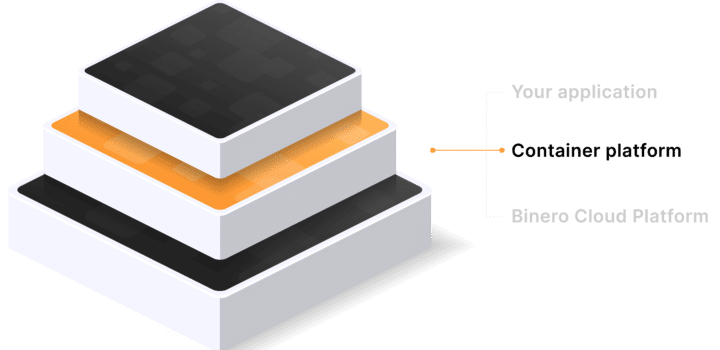
OpenShift/OKD can of course run on OpenStack. OpenShift uses OpenStack's API to allocate resources on the platform, but unlike VMware, you can also do it yourself, either via a web portal, API or via CLI.