Data centres are, without exaggeration, very energy-intensive facilities, and if operated incorrectly they quickly become environmentally hazardous. At Binero we have a well-developed environmental strategy with energy-efficient data centres that do not compromise on performance.
Our data centre uses renewable energy and generates reusable heat for residents. Binero STO1 was the first data centre in the world to receive the Fossil Free Data Centre certification.
We are proud to lead the way for a new generation of super-smart, super-green data centres.


We have a well-developed environmental strategy where our data centres are very energy efficient, but without ever compromising on performance. Binero's own data centre in Vallentuna uses renewable energy and generates reusable heat for the municipality's residents.
Our own data centre, STO1, is located in Vallentuna and is simply one of the world's most environmentally friendly data centres, with a strong focus on energy recovery, low current technology and cooling solutions – without compromising on performance, power supply or security.
In addition to our own data centre, we also rent space in a number of carefully selected, high-performance facilities around Sweden.
All parts of the energy and cooling network are redundant according to level A+B. This means that STO1 has two separate energy supply systems and two separate cooling supply systems, each redundant – both systems are designed to independently handle the entire load.
Specifically, the solution means that energy circuit A consists of mains power from a regional grid, a redundantly designed modular UPS and a diesel generator. Energy circuit B is identical but draws its power from another regional grid. Transformation from high voltage to low voltage takes place locally on the property, which enables incredible power resources, something uncommon in the Stockholm area.
The cooling systems are also redundant, where cooling circuit A takes its primary coolant from heat pumps connected to the district heating network and its secondary coolant from free cooling units located on the property. Cooling circuit B is designed similarly but with completely separate equipment.
Both energy and cooling circuits can be switched over for temporary operation on only one supply circuit to allow maintenance without taking a circuit out of operation. All racks are redundantly connected with energy from both circuits. The cooling system is designed to completely avoid so-called ‘hot spots’, which means that we distribute an even temperature across the entire surface – without any water hoses in the IT rooms (which is very unusual and a requirement to achieve the highest classification).

STO1 is connected via fibre from Skanova, Sweden's largest fibre provider. The fibre lines come from two different directions into the site's two MMRs (Meet Me Rooms).
For customers purchasing Internet capacity from us, we provide a redundant connection linked to four providers: Telia International Carrier, Telenor, Level 3 and Cogent, naturally separated via fibres running along different routes both internally and externally. This gives us very good digital routes both in Sweden and internationally. We guarantee that we always have at least 80% available excess capacity on our connections. The goal is to be able to handle a DDoS attack with minimal impact.
All internal cabling in the data centre consists of pre-terminated, fused OS2-class single-mode fibre (to minimise attenuation) and CAT 6A Ethernet, which supports up to 10 Gbps. The racks are connected from both MMRs. Connections from us (and also from external parties, if possible) are provided redundantly.
All racks are 600 mm wide and 47 height units (approximately 2200 mm) tall. The racks are equipped with electronic locks, meaning that the same electronic key (called 'tag') that grants access to the premises also grants access to the racks.
PDUs for power distribution are included in the racks, with a total of forty C13 outlets and three C19 outlets per side (A+B). The PDUs are mounted vertically and do not take up any space in the rack. They are also locally fused so that each PDU has six different groups of 16 amperes. This means that a faulty device can shut out a maximum of 1/6 of a PDU (e.g., in the event of a short circuit). In addition, those with access to the rack can reactivate a fuse that has tripped (which normally requires access to centrally located equipment).
Regarding capacity, each rack has two 32 amp power supplies. This means that the maximum power that can be loaded into a rack is 22 kW with full A+B redundancy or 44 kW with standard N+1 redundancy (diesel and UPS).
Cabling between racks is delivered entirely according to your requirements or our standard. All networks (both fibre and copper) are measured according to the strictest standards and logged to ensure that cabling is never a fault source.
We are driven by helping our customers achieve greater innovation and cost-effective IT. Would you also like to access the latest in high-performance cloud services?

STO1 is designed with operational staff in mind. The noise level in the IT rooms is significantly lower than in a typical data hall, as the cooling system's fans operate at much lower speeds. This contributes to a more pleasant working environment. Users can also book a temporary workspace directly next to the hall with a patch connection directly to a specific rack, as well as space for temporary or permanent storage of materials on-site in the hall.
If you prefer not to be on-site at all, we can also offer remote hands and remote eyes, even outside normal working hours. Our support organisation provides quick responses and our Network Operations Centre can resolve issues around the clock if needed. We can also receive materials on-site and store them securely until they are needed.
Of course, our customers have access to STO1 themselves, 24/7. The alarm system is designed to be easy to understand without compromising safety. Users receive access to an electronic key (known as a ‘tag’) and a code. These provide access to the correct zone and even the correct rack (requires a full rack).
All solutions are developed with the environment in mind. The equipment in a data centre runs continuously, and the energy used is converted into heat, which in turn must be cooled down. Normally, the cooling process consumes a lot of energy in addition to the cost of operating the equipment. PUE (Power Usage Effectiveness) is used to measure how efficient this process is. A PUE figure of 2 means that the same amount of energy is used to cool the equipment as to run it (1+1), while a PUE figure of 1.5 means that half as much energy is used for cooling as for operation (1+0.5).
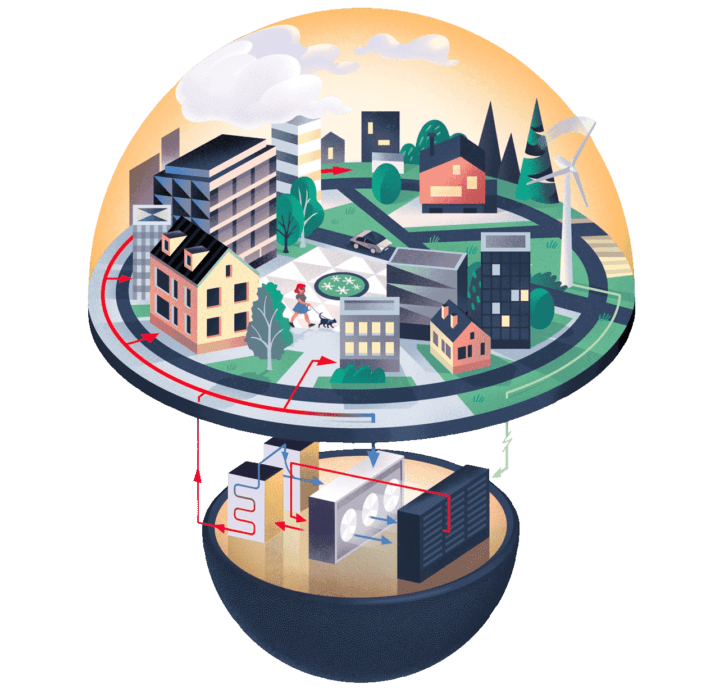
Our intention is to keep our PUE figure below 1.1 (around 1.05), which is extremely efficient. To further reduce our environmental impact, we also recycle all excess heat to the district heating network. This energy would otherwise have to be produced elsewhere, and when this is taken into account, we are close to being climate neutral. It is interesting to note that we generate 30% more heat than the cooling required. This means that for every watt we cool the equipment in the hall, we generate 1.3 watts of heat that is released and benefits the municipality's residents.
The lighting in the hall is 100% LED-based, which consumes very little energy. This is important because the lights must always be on for safety reasons. We have solar panels on the roofs that help us produce our own energy. All the energy we get from the regional network is ultimately eco-labelled, e.g. from wind power.

The entire property is surrounded by an electrified fence connected to an alarm centre. The buildings are made of concrete and all doors are security class 4, making it very difficult for unauthorized persons to access the property by mechanical means. The area is patrolled by security guards at random times around the clock, every day of the year.
The alarm's perimeter protection is only deactivated when a door is opened – the door can then only remain open for a certain time, after which the perimeter protection is reactivated (or the alarm is triggered). In addition to open doors (the walls have no windows), the perimeter protection also measures seismic activity (e.g. drilling). The security system knows when – and who – is in the premises and in different security zones (down to rack level), ensuring that no unauthorized persons can access sensitive functions (or information). When no authorized persons are in the buildings, the volume protection is automatically activated. All areas are monitored by surveillance cameras. Any alarms are sent to the police, the security company and our staff.
STO1 has the best possible fire protection in the form of Novec gas and aspirating detectors that detect the smallest signs of fire in all areas and extinguish it by lowering the oxygen level (without posing a danger to people in the premises). The fire alarm automatically alerts the fire brigade.
To guarantee operational reliability, cost efficiency, and future growth throughout the data centre's lifespan, we have considered a large number of parameters when selecting the site.
The basic requirements are access to sufficient energy and proximity to fibre in multiple directions. To meet our sustainability goals, the location must be close to district heating to recover surplus energy. From a security and usability perspective, it is better to build a new building than to rent space in an existing one. Additionally, ample space is required to avoid building multiple floors (which would necessitate water drainage on the roof). STO1 meets our high demands in every respect.